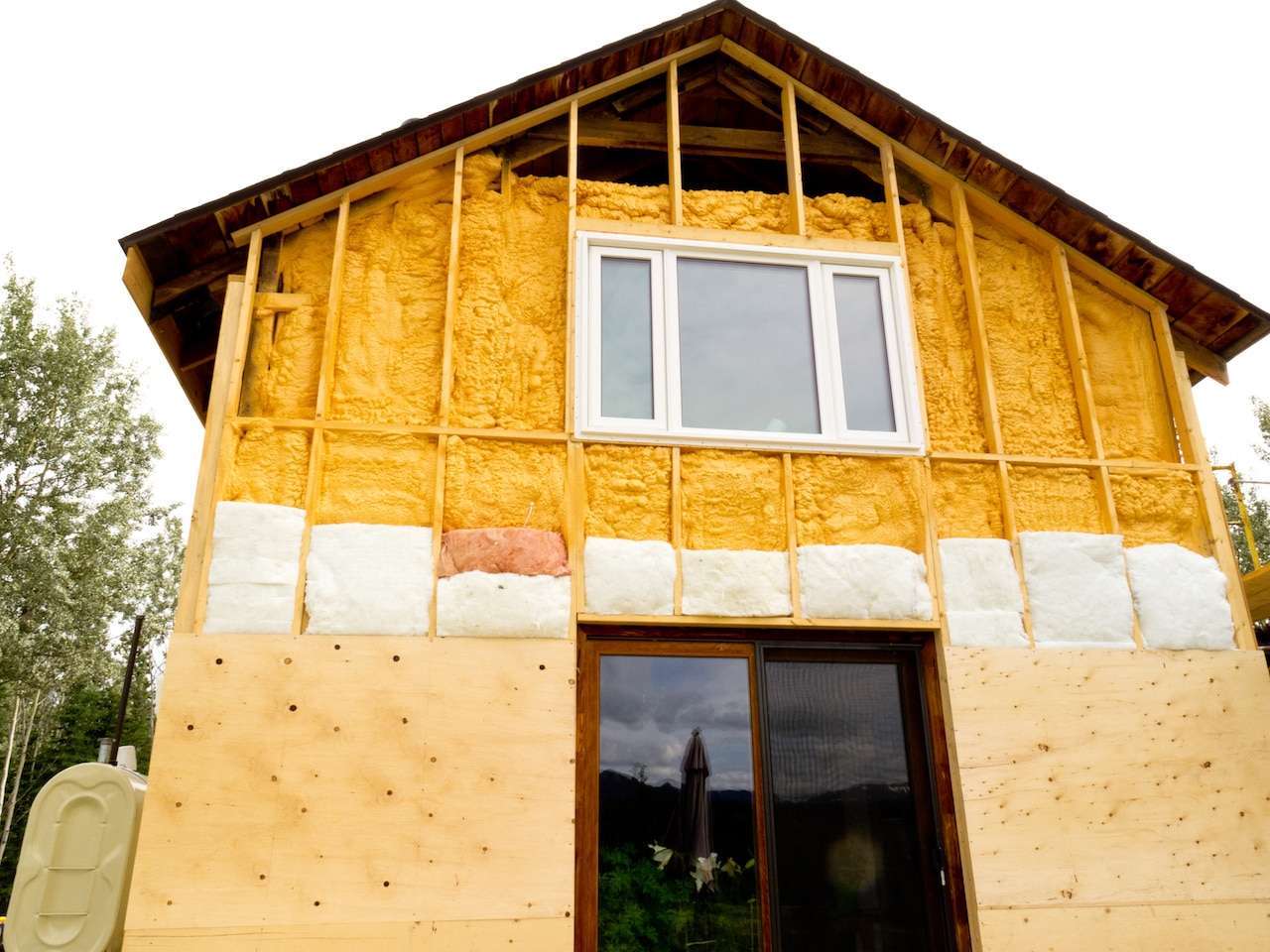
Insulation and air sealing solve two related but different building problems. Insulation slows heat transfer through walls, roofs, and floors, while air sealing reduces uncontrolled airflow through cracks, joints, gaps, and penetrations.
Spray polyurethane foam can do both. When applied correctly, spray foam air sealing creates an insulating layer while expanding into small gaps that would otherwise allow air to move through the building envelope. The U.S. Department of Energy describes spray foam as an excellent air barrier that can perform insulation and air sealing in one step.
That does not mean spraying foam anywhere automatically creates an airtight home. Coverage, thickness, continuity, installation quality, and the parts of the building being treated all determine how well the air barrier performs.
What Is Air Sealing?
Air sealing is the process of reducing unintended air movement between the inside and outside of a building.
Homes contain many small openings that are easy to overlook individually but can add up to substantial leakage.
Common Air Leakage Locations Include
- Gaps around plumbing pipes
- Electrical penetrations
- Attic access points
- Rim joists
- Wall-to-floor connections
- Roof-to-wall transitions
- Window and door framing
- Recessed fixtures
- Utility penetrations
- Cracks around framing
Air can move through these openings whenever pressure differences exist between indoors and outdoors.
That uncontrolled airflow can make heating and cooling harder because conditioned indoor air escapes while outdoor air enters.
Spray Foam Can Insulate and Air Seal at the Same Time
Traditional insulation materials do not always stop air movement by themselves.
Fiberglass batts, for example, can slow heat transfer while still allowing air to move through gaps around the insulation if the building has not been sealed separately.
Spray polyurethane foam behaves differently because it begins as a liquid mixture and expands after application.
As the material expands, it can conform to irregular surfaces and fill cracks, seams, and cavities.
Foam Insulation Solution describes SPF as expanding into small openings before hardening, allowing it to both insulate and reduce air infiltration through cracks, seams, and joints.
One Material Can Therefore Address Two Problems
Thermal problem:
Heat moves through walls, ceilings, and other assemblies.
Air leakage problem:
Air moves through openings in those assemblies.
Spray foam can help slow both when the installation creates a continuous layer.
Why Continuity Matters More Than Simply Having Foam
An air barrier works only when it remains connected across the area being protected.
A large section of spray foam with an untreated gap around a pipe, framing joint, or access hatch can still allow air to pass through that opening.
Think of the Air Barrier as One Continuous Boundary
A complete air-sealing strategy needs to connect across:
- Walls
- Ceilings
- Floors
- Attics
- Crawl spaces
- Rim joists
- Penetrations
The exact boundary depends on the design of the house.
The installer therefore needs to understand where the home’s pressure and thermal boundaries are located rather than simply filling each visible stud cavity.
Gaps at Transitions Can Reduce Performance
Some of the most important leakage locations occur where one building assembly meets another.
Examples include:
- Exterior wall to attic floor
- Foundation wall to framed wall
- Rim joist to floor assembly
- Roof deck to exterior wall
- Wall framing around windows
These junctions can be harder to seal with cut insulation products because dimensions are irregular.
Expanding foam can conform more closely to those transitions when applied correctly.
Open-Cell and Closed-Cell Spray Foam Can Both Reduce Air Leakage
There are two common forms of spray polyurethane foam used in residential insulation.
Open-Cell Spray Foam
Open-cell foam has a lower density and expands more aggressively during application.
EPA describes open-cell SPF as low-density foam that expands substantially and is commonly used for larger insulation applications.
Its expansion allows it to fill irregular cavities well.
Open-Cell Foam Is Commonly Used In
- Attics
- Roof assemblies
- Interior wall cavities
- Certain floor assemblies
At an appropriate installed thickness, it can form an effective air barrier.
However, open-cell foam remains vapor permeable, so air-barrier performance and vapor-control performance should not be treated as the same thing.
Closed-Cell Spray Foam
Closed-cell foam has a denser structure.
It generally provides:
- Higher R-value per inch
- Greater rigidity
- Lower vapor permeability
- Strong air-sealing performance at suitable thickness
Closed-cell foam is often considered where limited cavity depth, moisture exposure, or additional vapor resistance matters.
The right product depends on climate, building assembly, moisture strategy, and project goals.
Air Barrier and Vapor Barrier Are Not the Same Thing
This distinction is important because the terms are often mixed together.
Air Barrier
Controls air movement through the building assembly.
Vapor Retarder or Vapor Barrier
Controls water vapor diffusion through materials.
A material can stop air while still allowing some water vapor to diffuse through it.
Open-cell foam is a good example. It can work as an air barrier at sufficient thickness while remaining relatively vapor permeable.
Closed-cell foam has lower vapor permeability and may provide stronger vapor resistance depending on installed thickness and product specifications.
Why This Matters
A homeowner should not simply ask:
“Does spray foam block moisture?”
A better question is:
“What air, vapor, and bulk-water control does this wall or roof assembly need?”
Those are separate building-science decisions.
Spray Foam Air Sealing Can Help Reduce Drafts
Drafty rooms are often blamed on inadequate insulation.
Sometimes the larger problem is air leakage.
Cold outdoor air may enter around framing, electrical penetrations, attic bypasses, or rim joists.
Air Sealing Can Help With Rooms That Feel
- Drafty near exterior walls
- Colder around floors
- Difficult to heat
- Hotter in summer
- Different in temperature from nearby rooms
Foam Insulation Solution identifies reduced drafts and reduced air infiltration as core reasons for using spray polyurethane foam insulation.
If a room is uncomfortable because air is physically moving through building gaps, adding more insulation without sealing those gaps may not fully solve the problem.
Attics Are One of the Most Important Places for Air Sealing
Warm indoor air can move upward through openings between the living area and attic.
Common attic leakage points include:
- Plumbing penetrations
- Electrical wiring
- Top plates
- Attic hatches
- Chases
- Duct openings
- Ceiling penetrations
Traditional attic insulation can cover some of these areas without actually sealing them.
Spray Foam at the Roof Deck Changes the Boundary
In some homes, spray foam is applied to the underside of the roof deck instead of the attic floor.
This can move the thermal and air-control boundary from the ceiling level to the roofline.
The attic may then become part of the conditioned or semi-conditioned building enclosure.
That is a major building-envelope change and should be designed around ventilation, moisture, combustion appliances, and HVAC conditions rather than treated as a simple insulation replacement.
Rim Joists Can Leak a Surprising Amount of Air
The rim joist is located around the perimeter where floor framing meets the exterior wall.
This area contains many material transitions and joints, making it a common air-leakage location.
Spray Foam Can Help Seal Around
- Joist ends
- Foundation transitions
- Utility penetrations
- Irregular framing
Rigid insulation and sealant can also be used in some assemblies, but spray foam can simplify sealing where the geometry is difficult.
Closed-cell foam is commonly considered in these areas when the assembly also needs greater moisture resistance.
Spray Foam Can Seal Around Many Penetrations
Every opening through the building envelope creates a potential air path.
Penetrations can include:
- Pipes
- Electrical wires
- Cable lines
- Ventilation ducts
- Framing gaps
Expanding foam can conform around these penetrations rather than leaving the small gaps that may remain around cut insulation.
However, different products are used for different opening sizes and fire-safety conditions.
Not Every Gap Should Be Filled With the Same Foam
Certain areas may require:
- Fire-rated sealants
- High-temperature products
- Approved flashing
- Mechanical repairs
For example, foam should not simply be sprayed around heat-producing equipment without confirming the required clearances and approved materials.
Spray Foam Does Not Replace Bulk Water Control
Air sealing can help manage moisture carried by moving air, but it does not replace proper water management.
A leaking roof should be repaired.
A foundation allowing water intrusion needs drainage or waterproofing work.
A plumbing leak needs to be corrected.
Fix These Before Insulation
- Roof leaks
- Plumbing leaks
- Foundation seepage
- Wet framing
- Damaged flashing
- Exterior drainage problems
Installing insulation over an active water problem can hide the damage and make future repairs more difficult.
The building should manage liquid water first.
A Tighter Home Still Needs Ventilation
Reducing unwanted air leakage is useful, but a home still needs controlled ventilation.
EPA notes that weatherization and air sealing can reduce uncontrolled outdoor air exchange, which makes proper ventilation more important for managing indoor moisture and pollutants.
Everyday Indoor Activities Add Moisture and Pollutants
Examples include:
- Cooking
- Showering
- Laundry
- Cleaning products
- Occupant breathing
- Indoor combustion
A leaky house gets some accidental ventilation through cracks.
Once those cracks are sealed, relying on accidental leakage is no longer an appropriate ventilation strategy.
Mechanical ventilation may need to be reviewed depending on how tight the home becomes and how existing HVAC systems operate.
Air Sealing and Ventilation Have Opposite Jobs
This can seem confusing at first.
Air sealing: stops uncontrolled airflow.
Ventilation: provides planned airflow.
The goal is not to eliminate all air exchange.
It is to control where air comes from, where it goes, and how much enters the building.
Spray Foam Installation Requires Ventilation During the Work
The long-term goal may be a tighter building, but the installation process itself requires temporary ventilation.
EPA guidance for spray polyurethane foam explains that application can generate vapors, aerosols, mists, and dust that need to be controlled through ventilation and work-area isolation.
During Installation
Professional procedures can include:
- Isolating the work zone
- Creating directed airflow
- Exhausting contaminated air outdoors
- Sealing HVAC openings
- Using required personal protective equipment
- Restricting occupant access
EPA also advises continuing ventilation after installation and following the foam manufacturer’s guidance for safe re-entry time.
This is one reason large two-component SPF installations should be handled by trained professionals rather than treated like ordinary canned gap filler.
Installation Quality Determines Whether Spray Foam Actually Air Seals
The material can perform well, but poor application can leave gaps.
Problems Can Include
- Thin areas
- Missed framing connections
- Voids
- Foam pulling away from surfaces
- Inconsistent coverage
- Unsealed penetrations
An installer should inspect the completed work rather than assuming every area received proper coverage.
Substrate Conditions Matter Too
Foam needs to adhere to the surface.
Dust, moisture, oil, unsuitable temperatures, or other surface conditions can affect installation.
Preparation should follow the manufacturer’s application requirements.
A well-installed continuous layer is what creates the air barrier, not merely the fact that spray foam was used somewhere in the cavity.
Air Leakage Testing Can Show Whether Sealing Worked
A blower door test measures how much air leaks through a building envelope under a controlled pressure difference.
This can be useful before and after air-sealing work.
Testing Can Help Identify
- Overall air leakage
- Large hidden leaks
- Whether sealing improved the envelope
- Areas that need further investigation
Smoke pencils, infrared imaging, and other diagnostic tools can also help identify leakage paths under suitable conditions.
Testing is more informative than assuming a home became airtight simply because insulation was installed.
Spray Foam Air Sealing Works Best as Part of a Whole-Home Plan
Individual gaps matter, but the stronger approach is to identify the full building envelope before starting.
Before Installation, Determine
- Where the thermal boundary is
- Where the air barrier should be
- Which attic areas need treatment
- Whether rim joists leak
- Which penetrations require sealing
- Whether moisture problems exist
- Whether HVAC ducts are inside or outside the boundary
- Whether ventilation needs to change
- Whether combustion appliances are affected
This avoids solving one comfort problem while creating another building-performance issue elsewhere.
Does Spray Foam Air Seal Better Than Fiberglass?
Spray foam and fiberglass behave differently.
Fiberglass provides insulation but is not generally relied on as a complete air barrier by itself. Air sealing usually needs to be performed separately around cracks and penetrations.
Spray foam can combine those functions.
The Department of Energy specifically describes spray polyurethane foam as an excellent air barrier that can perform air sealing and insulation together when installed correctly.
That does not make fiberglass an unsuitable insulation material.
A well-designed wall can use fiberglass with a separate continuous air barrier and perform well.
The difference is that spray foam can provide both functions within one installation layer.
Use Spray Foam Air Sealing Where Continuity Can Be Maintained
Yes, spray foam insulation can also air seal a home. Its expanding application allows it to fill cracks, joints, irregular cavities, and penetrations while providing thermal insulation. The performance depends on proper thickness, continuous coverage, correct building-envelope design, and professional installation rather than simply applying foam wherever a draft is noticed.
Foam Insulation Solution installs spray polyurethane foam insulation for homes and buildings in New York and New Jersey, including applications intended to reduce air infiltration in walls, attics, crawl spaces, and other building-envelope areas. If drafts or uneven temperatures suggest that both insulation and air leakage may be involved, contact Foam Insulation Solution to evaluate where spray foam air sealing fits into the insulation plan.